The Maps We Make: How Perception Shapes Our Reality

Updated: 13 hours ago
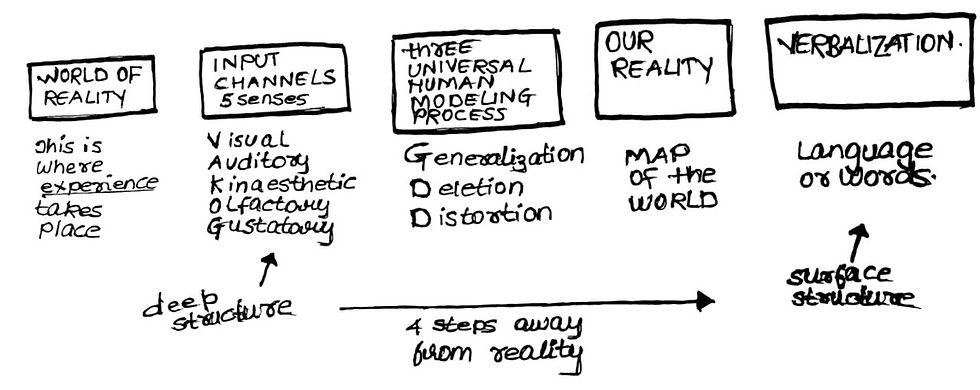
The way we experience the world is shaped not only by what happens around us, but also by how we interpret those experiences. Our memories, beliefs, values, language and past experiences influence what we notice and how we respond. In Neuro-Linguistic Programming (NLP), this idea is often described through the concept of an internal map of reality. Understanding how these mental filters work can help us recognise our assumptions, communicate more effectively and become more open to different perspectives.
How Does Communication Shape Our Behaviour?
The human psyche involves a complex interaction of thoughts, emotions, memories and behaviours. We experience emotions every day, and communication is an integral part of our lives. We communicate not only with the people around us but also with ourselves through our internal dialogue.
As Anthony Robbins is often quoted as saying, “The only thing standing between you and your success is the story you keep telling yourself!”
Our internal conversations can influence how we interpret situations, respond to challenges and approach our goals. The way we speak to ourselves may affect our confidence, motivation and emotional responses. However, our internal dialogue is only one of many factors that shape our behaviour. The external world is the world in which we live and participate. It includes the people we meet, the situations we encounter and the experiences we have. Although we may share the same environment, we do not necessarily experience it in the same way. Consider a workplace, for example. Two employees may have completely different opinions of the same manager. One might describe the manager as a great leader who provides direction and structure, while another might perceive the same person as controlling or dominating.
Why does this happen?
Our perceptions and behavioural patterns are influenced by a combination of personal experiences, expectations, beliefs, emotions, social conditioning and the context in which an event occurs. Consequently, two people can encounter the same situation and arrive at very different conclusions. To understand why we behave as we do, it is useful to explore how we receive information, interpret experiences and develop our individual maps of reality.
How Do We Take in Information From the World?

We gather information about our surroundings through our sensory systems. These systems help us detect and interpret different aspects of the environment, allowing us to interact with the world around us.
The five commonly described senses are:
Vision: Processing information about light, colour, shape and movement.
Hearing: Detecting and interpreting sound.
Smell: Detecting chemical signals through the olfactory system.
Taste: Detecting chemical properties through the gustatory system.
Touch and bodily sensation: Detecting pressure, temperature, pain and other bodily sensations.
In NLP, the term kinesthetic is often used broadly to refer to bodily sensations, movement and feelings.
When we see, hear, smell, taste or touch something, sensory receptors respond to relevant stimuli. This information is transmitted through neural pathways and processed by the nervous system and brain. The resulting perception depends on more than sensory input alone: attention, memory, expectations and context also play important roles. For example, when you eat a piece of chocolate, your taste receptors respond to chemicals in the food. Your brain processes this information alongside signals related to smell, texture and previous experiences, contributing to your perception of the chocolate as sweet and enjoyable.
However, perception is not simply a direct recording of the external world. The brain actively organises and interprets incoming information.
Why Can Two People Experience the Same Event Differently?
Imagine a group of people witnessing a car accident. Each witness may notice different details. One person might remember the colour of the vehicles, another may focus on the sound of the collision, while someone else may notice the movements of the pedestrians nearby.
Their accounts may differ because attention, viewing angle, emotional arousal, expectations and memory influence what they notice and later recall.
ach person may genuinely believe that their account is accurate. Yet confidence in a memory does not necessarily guarantee its completeness or accuracy.
This illustrates an important distinction: our experience of an event is not always identical to the event itself. Recognising this distinction encourages us to remain curious about other people’s accounts rather than automatically assuming that our own perspective contains the whole truth.
How Much Information Can We Process at Once?
At any given moment, our surroundings contain far more information than we can consciously attend to. A room may contain the ticking of a clock, a vibrating phone, birds chirping outside, a pen clicking on a desk and curtains moving in the breeze.
Although all these events may be occurring simultaneously, we usually focus on only a limited portion of them. Attention is selective. Information that is relevant to our current goals, expectations or concerns is more likely to capture our attention, while other information may receive little conscious processing.
The often-repeated claim that we receive two million bytes of information per second but consciously perceive only 134 bytes is not a well-established scientific measurement and should not be presented as a verified fact.
Research does, however, support the broader idea that human attention and working memory have limitations. George A. Miller’s influential 1956 paper discussed limits in immediate memory and information processing, popularising the phrase “seven, plus or minus two.” Later research suggested that working-memory capacity is often closer to three or four meaningful chunks under certain conditions, depending on the task and how information is organised.
These findings help explain why we cannot attend to every detail of our surroundings at once. We must select, organise and interpret information, and this process contributes to our individual experience of reality.
What Are Mental Filters, and How Do They Shape Our Perception?
In the NLP Communication Model, information from the external world is understood as passing through a series of mental filters before we form an internal representation of an experience.
These filters are commonly described as including:
Memories and past experiences
Beliefs and values
Attitudes and expectations
Language and cultural background
Emotional states
Personal interests and current goals
Habitual patterns of thinking and attention, sometimes described in NLP as meta-programs
These categories are part of the NLP framework rather than a universally accepted scientific taxonomy of mental processes.
Nevertheless, the general idea that prior experience, expectations, language, culture and goals influence perception is consistent with broader psychological research. Our filters can influence what we notice, what we remember, what we consider important and how we interpret the behaviour of others. Some of these influences are deliberate, while others operate without our conscious awareness.
For instance, someone who grew up in a household where academic achievement was strongly emphasised may interpret a poor examination result as a serious personal failure. Another person, raised in an environment that encouraged experimentation and learning from mistakes, may see the same result as an opportunity to improve. The event is similar, but its meaning differs because each person brings a different history and set of expectations to it.
How Are Our Beliefs, Values and Attitudes Formed?
Our beliefs, values and attitudes develop through a combination of learning, social interaction, personal experience, cultural influences and reflection. Childhood experiences can be especially influential, but people continue to revise their beliefs throughout life. Values refer to the principles or qualities we consider important, such as honesty, independence, achievement, family or compassion.
Beliefs are propositions we consider true or likely to be true. They may concern ourselves, other people or the world. For example, someone may believe that consistent effort improves performance. Attitudes involve our evaluations of people, objects, ideas or situations. They can include positive or negative feelings, beliefs and behavioural tendencies.
These concepts are related, but they are not interchangeable. Values may influence our beliefs and attitudes, while experiences and social environments can influence all three. Consider a person who grows up in a family that follows a vegan diet. They may learn to avoid animal products, develop beliefs about food and ethics, and form attitudes that influence their choices when eating with others.
Their response to a dish containing eggs may reflect family practices, personal values, ethical beliefs or dietary preferences. The same dish may have a completely different meaning for someone with another background. Understanding these influences helps us recognise that behaviour often has a history, even when that history is not immediately visible.
Do Childhood Experiences Determine Our Mental Filters?
Early experiences can have a lasting influence on how we understand ourselves and the world. Children learn through observation, imitation, reinforcement, relationships and direct experience. For example, a child who receives praise for being helpful may come to associate helping others with approval and belonging. Another child who is repeatedly criticised for making mistakes may become more cautious about attempting unfamiliar tasks.
However, development does not follow a rigid timetable in which the conscious mind is absent until age seven and only the unconscious mind operates. Children can show awareness, attention, learning and deliberate decision-making well before that age. Their cognitive abilities develop gradually and continue to change through adolescence and adulthood.
The concept of modelling is useful for understanding how people learn by observing others. Children may imitate parents, teachers, siblings or other role models, but they do not simply copy everything they see. Their learning is influenced by attention, relationships, consequences and individual differences. As we grow older, we can also reflect on the patterns we have learned and decide whether they continue to serve us.
What Are Meta-Programs in NLP?
Within NLP, meta-programs are described as habitual patterns through which people organise information, direct attention and respond to situations.
For example, when faced with a task, one person may focus primarily on what they hope to achieve, while another may focus on the problems they want to avoid. One person may prefer a detailed plan, while another may prefer flexibility. These descriptions can be useful prompts for exploring differences in preferences and communication. However, NLP meta-programs should not be treated as established personality categories or as scientifically validated tools for reliably predicting behaviour.
People respond differently depending on the situation, their goals and their circumstances. A person who prefers detailed planning at work may be spontaneous when spending time with friends. Rather than assigning someone a fixed label, it is more helpful to ask what matters to them in a particular context and how they prefer to approach the task at hand.
What Are Deletion, Distortion and Generalisation?
In the NLP Communication Model, deletion, distortion and generalisation are three processes used to describe how information may be selected, interpreted or organised as we make sense of an experience These terms are best understood as concepts within the model, not as a complete scientific account of how the brain processes every experience. They can nevertheless provide a useful framework for reflecting on common patterns of attention and interpretation.
What Is Deletion?
Deletion refers to selectively attending to some information while overlooking or leaving out other details.
Because we cannot focus on everything at once, selective attention is a normal part of everyday cognition. It becomes potentially unhelpful when the information we overlook is important to our understanding of a situation.
Example of potentially negative deletion:
Imagine a couple goes on a date. Most of the evening is enjoyable, but they have an unpleasant argument with a waiter. Afterwards, one partner describes the entire date as horrible, focusing almost exclusively on that incident and overlooking the positive parts of the evening. The unpleasant interaction may have been genuinely upsetting. The issue is not that the person noticed it, but that this single event may dominate their evaluation of the entire experience.
Example of potentially positive deletion:
Imagine a relative repeatedly makes rude comments about your appearance or choices. You decide not to dwell on every remark and instead focus your attention on your own goals and the people who treat you respectfully. In this case, choosing not to give every comment your attention may protect your well-being. However, ignoring repeated mistreatment is not always the best response; setting boundaries or seeking support may be more appropriate. The important question is whether the information being overlooked is irrelevant, unhelpful or necessary for making a sound decision.
What Is Distortion?
Distortion refers to interpreting information in a way that differs from the available evidence or from what ultimately turns out to be the case. Our expectations and previous experiences can influence how we interpret ambiguous situations. This can help us make quick sense of the world, but it can also lead to misunderstandings.
Example of perceptual distortion:
You see someone from a distance and believe they are a friend. As the person approaches, you realise that they are a stranger who looks similar to your friend. Your initial interpretation was mistaken, but it was understandable given the limited visual information available.
Example of an unhelpful interpretation:
A new student joins a class and speaks very little during the first few lessons. Another student concludes that the newcomer is dull or boring. However, the new student may be shy, tired, anxious about entering an unfamiliar environment or simply taking time to become comfortable. The conclusion goes beyond the evidence available.
This kind of interpretation can affect relationships because we often respond to what we think someone’s behaviour means rather than checking what is actually happening. A more open response would be to remain curious and allow the person an opportunity to express themselves.
What Is Generalisation?
Generalisation occurs when we use previous experiences to form expectations about similar situations, people or events. Generalisation is not inherently negative. It allows us to learn from experience and apply that learning to new circumstances. The difficulty arises when a conclusion becomes too broad or rigid.
Example of negative generalisation:
A stand-up comedian performs in front of a live audience several times, but the performances do not go well. The comedian concludes, “I’m not a good comedian” or “I’ll never be able to perform successfully.”
These conclusions turn a limited number of experiences into a judgement about permanent ability. They overlook other explanations, such as preparation, audience preferences, stage experience or the quality of the material. A more balanced interpretation would be: “Those performances did not go as I hoped. I can review what happened and work on improving.”
Example of positive generalisation:
You enjoy several films directed by the same filmmaker and begin to expect that their future films will also appeal to you. This expectation may be reasonable, but it is not a guarantee that every film by that director will suit your tastes.
Generalisation helps us learn, but it is important to recognise when a useful pattern becomes an assumption that prevents us from noticing new information.
How Do These Processes Influence Communication?
Imagine giving a presentation to a group of five people. You share the same information with everyone, but when you ask them what they understood, you receive five different interpretations.
One person may focus on the main argument, another on a particular example, another on the emotional tone, and someone else on how the information relates to their own experience.
Each listener brings different knowledge, expectations, interests and concerns to the conversation. The differences do not necessarily mean that the speaker communicated badly or that the listeners failed to understand. They may indicate that people attended to different details or interpreted the same words in different contexts.
This is why effective communication involves more than delivering information. It also requires checking what the other person understood, clarifying ambiguous statements and remaining open to feedback..

What Is an Internal Representation of Reality?
After we receive and interpret information, we develop a mental understanding of what has happened. This may include memories, images, thoughts, emotions, assumptions and conclusions.
In NLP, this internal representation is often described as a map of the world. The metaphor is simple: a map helps us navigate a place, but it does not contain every detail of the territory itself. In the same way, our mental representation of an experience helps us understand and respond to it, but it does not necessarily capture every aspect of what occurred.
Consider attending a party with a group of friends. One person remembers the music and dancing, another remembers a conversation that made them feel included, while someone else remembers feeling uncomfortable in the crowd. They attended the same event, but their experiences differed because they noticed and interpreted different aspects of it.
Their memories may also change over time as they reflect on the event or discuss it with others. The NLP map metaphor encourages us to distinguish between an event and our interpretation of that event. It does not mean that external reality is irrelevant or that every interpretation is equally accurate. Some interpretations are better supported by evidence than others.
How Does Our Internal Map Influence Our Emotional State?
Our interpretation of an event can influence the emotions we experience, the bodily responses that accompany those emotions and the actions we take.
In the NLP model, this sequence is often described as:
External event → Internal representation → Emotional state → Physiology and behaviour → Outcome
This is a simplified framework, not a universal sequence in which every step occurs independently or in the same order. In practice, thoughts, emotions, bodily responses and behaviours can influence one another.
For example, imagine that your manager sends you a message saying, “We need to discuss your work tomorrow.”
You might interpret the message as a sign that you have made a serious mistake. That interpretation may lead to anxiety, physical tension and difficulty concentrating. Another person might interpret the same message as a routine opportunity to discuss a project. They may feel relatively calm and prepare a list of questions.
The message is identical, but the interpretations differ.
Neither interpretation can be confirmed from the message alone. The most useful next step may be to gather more information rather than treating an initial assumption as a fact. This illustrates how examining our interpretations can help us respond more thoughtfully to uncertainty.
How Do Our Mental Maps Differ From Reality?
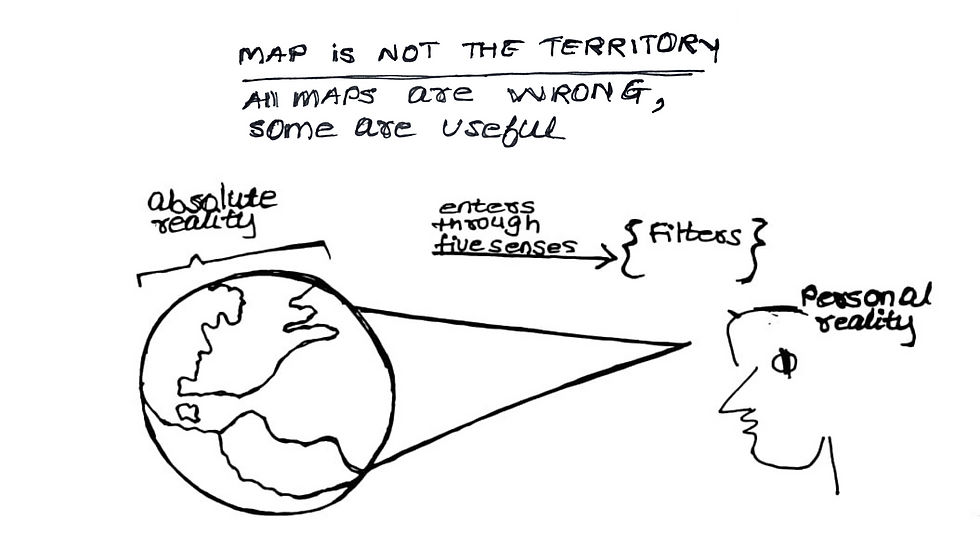
We often experience our own interpretation of a situation as though it were the situation itself. We may assume that our conclusions are obvious, objective or universally shared.
However, our perceptions are shaped by limited information, prior learning, current emotions and the context in which we encounter an event. For example, consider someone who is afraid of heights. Is height itself the entire problem?
Not necessarily. The fear may involve an interpretation of the situation, such as expecting to fall, believing that a balcony is unsafe or imagining a frightening outcome. The person’s bodily response may then intensify the experience of fear. At the same time, some heights and elevated locations do involve genuine physical risks. It would be inaccurate to assume that every fear is merely a mistaken mental representation.
The useful distinction is between assessing an actual risk and examining how we interpret that risk. When a fear is disproportionate, persistent or limiting, professional support may help a person understand and address it. The map metaphor can be helpful because it reminds us to ask whether our interpretation is supported by the available evidence and whether other explanations are possible.
When our understanding becomes more flexible and better informed, we may gain additional ways of responding to the situation.
What Are Deep Structure and Surface Structure in NLP?

In NLP, surface structure and deep structure are terms used to describe the relationship between what a person expresses in language and the fuller experience or meaning that the language is intended to convey.
These terms have a particular history in NLP’s linguistic model. They should not be confused with a complete or definitive scientific distinction between a person’s account and an objectively recoverable version of the past. When people describe an experience, they necessarily select certain details. Their account may include what they remember, what they believe happened, how they felt and what they think the experience means.
Other details may be omitted because they seem unimportant, are difficult to remember or are not relevant to the point they are trying to communicate. The resulting account is not necessarily deceptive or inaccurate. It is a human description of an experience, shaped by memory, language and perspective.
How Can a Therapist Explore a Client’s Map of Reality?
When a client comes to therapy, they may describe a difficult experience and the conclusions they have drawn from it.
For example, a client may say, “I always fail when I have to speak in public.”
A therapist would not automatically assume that this statement is a complete or objective account of the client’s experiences. Instead, the therapist might explore what the client means by “always,” which situations they are referring to, what happened during those situations and how the client evaluates their own performance. The therapist may also explore the client’s thoughts, emotional responses, expectations and behavioural patterns.
Useful questions might include:
What happened during the specific situation you are describing?
What did you notice at the time?
What were you thinking and feeling?
What makes you conclude that the experience was a failure?
Have there been situations in which speaking in public went differently?
What evidence supports your conclusion, and what evidence might challenge it?
How would you interpret the event if a friend had experienced the same thing?
These questions can help distinguish between the event, the client’s memory of it, the meaning they have attached to it and the conclusions they have drawn.
The aim is not to tell clients that their perceptions are wrong. It is to understand their experiences accurately and help them consider alternative interpretations where appropriate. Therapeutic work should also take the client’s feelings seriously. A person can experience genuine distress even when some of their assumptions about a situation are uncertain or inaccurate.
How Can We Move From a Surface Account to a Fuller Understanding?
Imagine a client who once forgot their lines during a speech. The audience waited while the client struggled to remember what came next.
The client later concludes:
“I am a terrible speaker.”
“Everyone noticed how nervous I was.”
“I will never be able to speak confidently in front of an audience.”
These statements contain more than a description of the event. They include interpretations about how the audience responded, judgements about the client’s ability and predictions about the future.
A fuller exploration might reveal that the client had prepared well but had not rehearsed under realistic conditions. Perhaps they were tired, felt pressured by the audience or became distracted after losing their place. Some audience members may have noticed the pause, while others may not have considered it particularly important.
The therapist should not invent alternative details or assume that the audience was supportive. Instead, they can help the client identify what is known, what remains uncertain and what conclusions may have gone beyond the available evidence. The client might then develop a more balanced understanding: “I lost my place during that speech, and it was uncomfortable. That does not establish that I am incapable of public speaking. I can practise and learn ways to manage similar situations.”
This change does not erase the event. It changes the meaning the client attaches to it and may create more options for future action. Within the NLP framework, this process can be described as exploring the person’s map of reality and the filters that shaped it. In evidence-based psychological practice, similar work may involve examining automatic thoughts, evaluating evidence and developing more flexible interpretations, as seen in cognitive behavioural approaches.
Why Are Acceptance and Allowance Important in Relationships?

People often interpret the world through their own experiences and expectations. As a result, we may find it difficult to understand why another person sees a situation differently. When we focus exclusively on our own perspective, we can overlook information that might help us understand a disagreement or solve a problem.
Recognising that people have different perspectives does not mean that every perspective is equally accurate or that harmful behaviour should be excused. It means acknowledging that our understanding is incomplete and that another person’s experience may contain information we have not considered. This attitude can support empathy, clearer communication and healthier relationships.
How Can We Learn to Respect Other People’s Perspectives?
Imagine two colleagues disagreeing about a project deadline. One believes the deadline should be strict because the team has made a commitment to the client. The other believes the deadline should be flexible because the project requirements have changed.
If both insist that their own position is the only reasonable one, the discussion may become a conflict about who is right. However, if they explore the concerns behind each position, they may discover that both are trying to protect something important: one is prioritising reliability, while the other is prioritising quality and feasibility.
Understanding these concerns does not guarantee agreement, but it can help them identify a solution that takes both into account.
We can widen our understanding by asking questions such as:
What matters most to the other person in this situation?
What experiences might have influenced their perspective?
Which parts of their account can I understand, even if I disagree?
What information might we both be missing?
Is there a practical solution that respects our different concerns?
Respecting a perspective is not the same as agreeing with it. We can listen carefully, recognise another person’s feelings and still disagree with their interpretation or decision.
What Is the Difference Between Acceptance and Allowance?
The terms acceptance and allowance can be used differently across psychological, philosophical and personal-development frameworks. In this article, they are used in a practical sense to describe two related approaches to dealing with differences.
Acceptance involves acknowledging a situation as it currently is, rather than denying its existence or spending all our energy wishing it were different. Allowance, as used in this framework, involves giving another person or situation room to be different without feeling compelled to control or change it simply because it does not match our preferences.
Consider a relationship in which one partner is less verbally expressive than the other.
Acceptance may involve recognising that your partner does not naturally communicate affection through frequent verbal reassurance. Allowance may involve respecting this difference while exploring other ways of expressing and receiving care.
This does not mean that one partner must ignore their own needs. If verbal affection is important to one person, they can communicate that need and discuss a compromise. Allowing differences to exist does not require abandoning boundaries, tolerating disrespect or remaining in an unhealthy relationship.
A balanced approach recognises both people’s needs and preferences.
How Can Acceptance Help Reduce Conflict?
Conflict often intensifies when we interpret differences as proof that another person is wrong, uncaring or unreasonable.
For example, someone who prefers to discuss problems immediately may interpret a partner’s need for time alone as indifference. The partner, however, may need time to process emotions before talking. If both people assume that their own approach is the only acceptable one, the disagreement can become more intense.
Recognising the difference allows them to discuss what each person needs. They might agree to take a short break and return to the conversation at a specific time. This does not eliminate the disagreement. It creates a way to address it without assuming that the other person’s different response automatically reflects a lack of care.
The same principle applies to self-awareness. We can acknowledge our own habitual reactions without treating them as permanent characteristics or criticising ourselves for having them.
When we recognise our assumptions and remain willing to reconsider them, we create more room for understanding and constructive action.
How Can We Become More Aware of Our Mental Maps?
Our perceptions are influenced by many factors, and we cannot eliminate every bias or limitation in our thinking. However, we can develop habits that help us examine our interpretations more carefully.
Here are five practical ways to begin.
1. Separate Facts From Interpretations
When something upsetting happens, write down what you know occurred and what you believe it means.
For example:
Observation: My colleague did not reply to my message today.
Interpretation: My colleague is angry with me.
Other possibilities: They may be busy, may not have seen the message or may need more time to respond.
The purpose is not to assume that the most reassuring explanation is correct. It is to recognise that the available evidence may not support a single definite conclusion.
2. Question Absolute Statements
Words such as “always,” “never,” “everyone” and “nothing” can sometimes signal that a conclusion has become too broad.
If you find yourself thinking, “I always make mistakes,” ask yourself which specific situations you are referring to.
A more precise statement might be, “I made two mistakes on this task, and I need to understand why.”
Specific descriptions make it easier to identify what can be changed.
3. Consider More Than One Perspective
When you disagree with someone, try describing their position in a way they would recognise before explaining your own. This can help you identify misunderstandings and distinguish between a disagreement about facts and a disagreement about priorities or values. You do not need to abandon your own position to understand theirs.
4. Look for Evidence That Challenges Your Assumptions
People naturally tend to notice information that supports what they already believe. This tendency is often discussed in psychology as confirmation bias.
To counter it, ask yourself what evidence would lead you to reconsider your conclusion.
For example, if you believe that you are poor at public speaking, look for specific evidence from different presentations rather than relying only on your most uncomfortable experience. The aim is to form a balanced judgement, not to replace a negative assumption with an equally unsupported positive one.
5. Stay Open to Revising Your Map
Our beliefs and interpretations can change as we gain new experiences and information.
You may have believed that a particular person was unfriendly because they rarely initiated conversations. Later, you may discover that they are shy or unsure whether others want to speak with them. New information does not always require us to change our conclusions, but it gives us an opportunity to evaluate them more accurately.
Flexibility means being willing to update our understanding when the evidence warrants it.
Conclusion: Can Changing Our Map Change Our Experience?
The way we interpret the world influences our emotions, decisions and interactions. Our memories, beliefs, values, expectations and attention shape what we notice and the meaning we assign to our experiences.
The NLP Communication Model offers one way of thinking about these processes through the metaphor of an internal map of reality. Its concepts of deletion, distortion and generalisation can encourage us to examine what we notice, how we interpret events and where our conclusions may extend beyond the available evidence. However, our mental maps are not the only factors shaping our lives. External circumstances, social conditions, physical health, relationships and practical constraints also matter. Changing an interpretation cannot automatically change every aspect of reality.
What we can do is become more aware of the relationship between events and our interpretations of them. We can question assumptions, seek additional information, listen to different perspectives and develop more flexible responses.
As Richard Bandler is often credited with saying, “Our biggest limit is not in what we want and cannot do; it is in what we have never considered that we can do.”
The broader lesson is that greater awareness can reveal possibilities we had not previously considered. When we are willing to examine our own maps, we may discover new ways to understand ourselves, communicate with others and respond to the world around us.
Our map may never contain the entire territory, but we can continue to make it more informed, flexible and useful.
References
James, T. (2003). What is NLP: A model of communication and personality. Withdrawn 8th Februarie.
NLP Communication Model: What are you missing?. Unleash Your Potential. (2021). Retrieved 30 April 2021, from https://unleashyourpotential.org.uk/nlp-communication-model/.
Sibley, Kevin. (2006). The NLP Communication Model Applied to the Engineering Classroom. 207-223.
Understand the NLP Communication Model to get your point across!. Actionable Leadership Guides. (2021). Retrieved 30 April 2021, from https://www.the10minuteleader.com/nlp-communication-model/.
What is NLP? NLP simply explained. Landsiedel.com. (2021). Retrieved 30 April 2021, from https://www.landsiedel.com/en/nlp/what-is-nlp.html.
What is the NLP communication model? - Performance Partnership. Performance Partnership. (2021). Retrieved 30 April 2021, from https://performancepartnership.com/nlp-communication-model/#.

This article on 'The Maps We Make' has been contributed by Shreya Bhatte, who is a Psychology student from Maniben Nanavati Women’s College, Mumbai. She is part of the Global Internship Research Program (GIRP), which is under the leadership and guidance of Anil Thomas. GIRP is an Umang Foundation Trust initiative to encourage young adults across our globe to showcase their research skills in psychology and to present it in creative content expression.
She is passionate about psychology and has this constant curiosity to expand her knowledge in the field. She is more of listener and believes that there’s a lot to learn from every individual that we meet. She likes dancing and watching sports.
Anil is an internationally certified NLP Master Practitioner and Gestalt Therapist. He has conducted NLP Training in Mumbai, and across 6 other countries. The NLP practitioner course is conducted twice every year.