What else could this mean !

For me, reframing is about giving meaning, discovering meaning or changing meaning. It is through these creative attempts that we discover a new meaning and that a new relation emerges. Sometimes it is about editing some components of a narrative, the way it is kept and held in the client's psyche so that something in the client's experience could change, shift and move. This change might happen when the content changes, when the syntax within the content changes or when the context itself changes. It is when we change the meaning associated with the projection that we begin to create more choices around that projection, object or experience. If black means negative and dark, then that meaning gives the client a particular range of options and possibilities when they encounter black. Imagine instead that the client discovers that black is the color of the universe, filled with infinite space, stars and light. Or imagine the client discovering that black is the contrast on which white can be written, like a blackboard. In those little moments of reframe, something might happen for the client; an epiphany may be. The meaning changes and with it comes more options and choices within the context they were earlier. Change comes after choice and choice becomes a metaphor for agency and autonomy in the client's life.
Whether we are talking about a reframe, preframe, outframe or inframe, I think we are working with this same principle. I remember learning this concept with Judith (Judy) DeLozier in Moscow. She said that when you look up at the night sky, you see so many stars. Imagine taking an imaginary frame and placing it around a few of those stars. Now you see the constellation. Till now it was the night sky, the whole or maybe clusters or a single star. The frame lets you see the constellation (meaning, relation and association) You may see the constellation of a kite, a square or even a cat. The stars come to have more meaning and shape now that the frame is placed around them and we connect them with our imagination. The cat appears through the frame. That is what framing does. The stars continue to remain stars but the way we connect with them changes. Our meaning of them changes and so the night sky becomes relatable in a way that it wasn't till now.
If I take a red sharp single light and keep it fixed in a particular place, then take a balloon and let this light pass through the balloon, I will realize that this red, thin, straight light will form a circle. That is the reflected area of the light on the balloon. As I move the balloon left or right in front of and perpendicular to that light, I will realize that the elliptic reflection of light that is formed keeps growing in size or reducing in size.
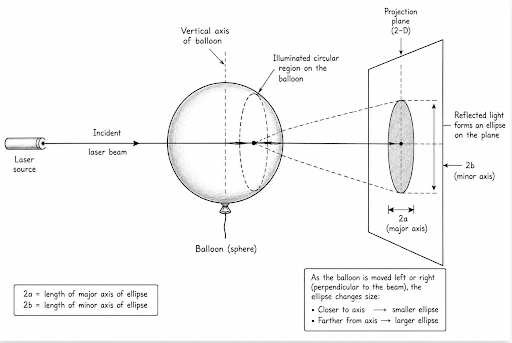
What I am seeing is the balloon through the lens of a 2-D plane. There is a balloon but within a 2-D plane, all it could cast is the ellipse. How do I tell you in the 2-D plane that it is a shadow or a reflection of the balloon, which is 3-D? All that the shadow or reflection could give in a 2-D plane is what interacts with that plane. An ellipse in a 2-D plane could be the way a three-dimensional balloon passes through a plane, but the plane could perceive only that much.
I wonder if I am a reflection or a projection of a 4-D object.
I am trying to understand reframing through this. As I change the meaning or the context, how everything changes reminds me of a poem that I read once. I think it was Rumi, “I was dreaming of a butterfly, now I am awake.” I am wondering if I am a human being in a butterfly's dream.
Well, funny as it sounds, as I change the meaning, as I change the context, as I change some components of the dream, as I change the associations within the frame, everything changes. Meaning is just ready to change as I am willing to alter the aspects with which I am holding the existing meaning.

Imagine a tesseract. I can only talk about it, I can tell you how the drawing would look, but in the three-dimensional world, I would never be able to draw a tesseract. It is insane. My existing world would have its limitations. So this is where I have to do with imagination and imagination alone. That is where reframing becomes important.
Let me share with you something I remember from a conversation with Judy. She was speaking about the way she had heard Dr. Erickson narrate a case.
Erickson described a woman who came into his office one morning and said, “I’ve got a very bad sinus. I know this is correct. My face is aching and my face is hot. I’ve got a horrible headache. And I don’t think I have been behaving very well. My sexual behavior has been pretty bad. I don’t think I’m improving at all. I think I’m slipping. I think I’m going backwards.”
Imagine for a moment that this woman is your client and you are sitting across from her wondering where to begin. What would you listen for? Would you begin with her physical symptoms? Would you explore her sexual behavior? Would you follow her sense that she is slipping or going backwards?
Erickson continued by saying, “I don’t know what it was in her tone of voice.”
Later, he described something more specific about what he heard in her voice. There was a desperate note when she spoke about her face aches and her sinus. He spoke about that quality in a person's voice when they have reached a point where the aggravation has become too much. He asked a very simple question. How do you recognize that?
Then Erickson said to her, “Well, what do you really think?”
She said, “I wonder if I’m in pretty serious shape.”
Erickson repeated her question. “You wonder if you’re in pretty serious shape. Do you want to repeat that question again but change it slightly?”
She said, “I’m wondering if I’m going crazy.”
Now listen to what has happened. The content has changed, the question has changed. The meaning wrapped underneath the question also begins to be open up itself differently.
Erickson continued.
“I said, ‘That’s not your question at all, and you know it, and I know that you know it too. I think it’s about time you stopped all of that pretense. I’ve been trying for a long time to get you to face the facts. You’ve been afraid. You wouldn’t do it. You’ve gone in every direction. And you know your headaches have been increasing. Your body pains have been increasing. Everything, now go ahead and ask that question.’
“She said, ‘All right, is my husband an alcoholic?’
“I said, ‘Would you ask that question if it weren’t true?’
“She said, ‘No.’
“‘So what are you going to do about it?’”
And suddenly the conversation hit a whole new direction and depth.
The woman who had entered the conversation talking about her sinus, her face, her headache, her sexual behavior and her sense that she was going backwards, the context just moved into something so different, its a vulnerable moment for the client.
This is what interests me about the story, the idea and concept of reframe put into an application.
Erickson had been seeing this woman for some time. He had the background of the relationship and the history of the work. That context would have given him a different position from which to listen to her. His directness was part of that particular therapeutic relationship.
For me, this is where reframing becomes interesting.
Sometimes the reframe is not about giving the client a completely different answer. Sometimes it begins by changing the question. The question changes the frame and the frame changes what becomes available to be seen. The woman had been talking about one thing while something else was asking to be heard. Erickson's intervention brought the question into a different frame. Once that happened, another meaning became available. And perhaps that is one of the things we are doing when we work with frames. We are not necessarily changing the stars. We are changing which stars we are connecting and therefore what constellation begins to appear.
Changing the frame around a word
Often a client says a word that is “marked out,” emphasised through a change in volume, tonality, facial expression or gesture, almost as though the word is carrying another message beyond its ordinary meaning. Sometimes the client is puzzled by a particular word or uses a word that feels unusual in the context of what they are describing. At other times, the word may be very general and we may want to explore what the experience means more specifically. Erickson had an interesting instruction for moments like these. He would ask the client to “spell the same word with another set of letters, so that it would read like a different word.” Imagine closing your eyes, bringing the word into your awareness and allowing the letters to separate, move around and come together again in a different arrangement. The same process could be explored through sound by noticing each sound in the word, moving the sounds around, hearing them in a different sequence and allowing a new word to emerge. What interests me here is not whether the exercise produces a particular answer. It is the invitation to loosen the relationship between the word and the meaning that has been attached to it. A word that seemed fixed begins to have movement in our experience. The client could discover another association, another image, another sound or perhaps another meaning. This is where I see a beautiful connection with reframing. The letters remain the letters. The sounds remain the sounds. Yet when their relationship changes, the word changes and with it, perhaps, the experience connected to that word.
Activity : Think of a word that you have used recently which seems to carry particular importance for you may be a word that is associated with a painful (unwanted event) or something else that is bothering you. Close your eyes and bring that word to mind. Now spell the same word with another set of letters so that it would read like a different word. Allow yourself to notice what happens as the letters change, rearrange or come together differently. You could imagine seeing the letters moving in space or you could hear the individual sounds changing their sequence. Notice what new word emerges and what meaning, association, image or feeling comes with it. You could repeat the process with the new word if another meaning seems to be waiting to be discovered. There may be a different word, a different association or perhaps nothing further at all. Simply notice what your experience gives you.
Framing and reframing
From an NLP stand point, reframing refers to changing the frame through which an experience is understood so that a different meaning could become available. Bandler and Grinder developed reframing within their early work on language, behaviour and experience and later explored it more extensively in Reframing (1982). Robert Dilts developed the idea further by examining how language could alter the frames surrounding beliefs and the meanings attached to them. The distinction between context reframing, where the meaning of an experience is changed by placing it in a different context, and content reframing, where the meaning is changed by finding a different significance within the same experience. The work also includes changing frame size, redefining terms, exploring intention and shifting the relationship between an event and the belief formed around it. A frame therefore becomes more than a boundary around information. It becomes the context through which information is organised and experienced. The same event could carry different meanings depending on where it is placed, what is emphasised, what is connected to it and what is left outside the frame. This is also where the distinction between content and context becomes useful. Content asks what happened or what is being experienced. Context asks where, when, with whom, under what circumstances and in relation to what else that experience is being held. A change in either could alter the meaning associated with the experience. This idea could be further extended into conversational belief change through fourteen verbal patterns that work with different aspects of a belief, including intention, consequence, redefining, analogy, changing frame size and changing the context in which the belief is being considered. Preframing, in this language, involves establishing a frame before an experience or conversation unfolds. Reframing changes the frame around an existing experience. Outframing places an experience within a larger frame of reference while in framing could bring attention to a particular aspect of the experience itself. These distinctions give the practitioner different ways of working with meaning. The purpose is not simply to replace one interpretation with another. It is to explore what else the experience could mean when the frame around it changes. In this sense, reframing becomes an exploration of meaning, context and choice within the client's experience.
Imagine a parent saying, “My son is aggressive.” We could separate the person from the behaviour and say, “Your son is a person who is behaving aggressively in this situation.” Something has already changed. The boy is no longer the behaviour. We could then look at the behaviour itself and ask what else it could mean. What if the aggression is also an attempt to protect himself, establish a boundary or be heard? This as the pattern of Intention, where attention is directed towards the purpose or intention behind a behaviour rather than remaining with the behaviour itself. Something similar happens when we separate behaviour from identity. “I am lazy” could become “I have been behaving in ways that I describe as lazy.” The experience has not been erased. The frame around the experience has changed. There is another example that I find equally interesting. A person says, “She criticises me because she wants to hurt me.” We could separate the behaviour from the intention and ask, “What if her criticism is connected to something she is trying to communicate, protect or change?” The question itself creates another place from which to look. This is Intention and Redefining becomes another way of changing the words through which the experience is held. The person remains the person, the behaviour remains the behaviour and the intention remains something we could explore. Yet the relationship between them has changed. Perhaps this is what makes reframing so fascinating to me. We are not necessarily changing what happened. We are changing the frame through which we meet what happened. And sometimes a different frame is enough to let us see that there was always more in the experience than the first meaning we gave it.