Judith DeLozier: The First Lady of NLP

The woman who transformed NLP through presence, not just process.
A Presence That Cannot Be Explained

There is a certain kind of presence in life so rare, so warm, that describing it feels like trying to capture a rainbow. Judith DeLozier, a key figure in NLP is one such presence.
Known to many simply as Judy, Judith DeLozier is not only a co-developer of NLP, but a living, breathing embodiment of it. Her presence itself is therapeutic. Many
describe that even before she speaks, something inside them softens, expands, and finds its breath again.
“The best and most beautiful things in the world cannot be seen or even heard, but must be felt with the heart.”
Her work is not loud. It unfolds slowly, until one day, it lives within you.
Judith grew up in Oklahoma as the only sister among six brothers. Her academic journey led her to anthropology at the University of California, Santa Cruz, where her curiosity about human systems deepened.
She became part of the original student group of John Grinder and Richard Bandler, thus placing her at the very birth of NLP.
Her learning was further deepened through her time with Milton Erikson, where she began to understand the power of trance, metaphor, and the quiet precision of language in healing, insights that would go on to influence the very fabric of NLP.
Early Influences:
•Anthropology & cultural systems
•Dance (ballet & Congolese traditions)
•Hypnosis & language patterns
•Systems thinking & ecology of mind
Co-Creating the Foundations
Since 1975, Judith DeLozier has been a central force in shaping NLP, with her work in NLP continuing to influence how transformation is understood today. As a part of the original group, she contributed to the development of core models and processes.
She co-authored Neuro-Linguistic Programming Vol. I with Robert Dilts, John Grinder, and Richard Bandler, contributing to one of NLP’s most fundamental techniques: Reframing.
Major Contributions:
•Reframing
•Perceptual Positions
•Attention Training
•Somatic Syntax (with Robert Dilts)
•Dancing S.C.O.R.E.
•New Code NLP
She later co-authored Turtles All the Way Down with John Grinder, exploring the relationship between NLP, culture, art, and epistemology, leading to New Code NLP, a more systemic and holistic approach.
“If you can’t heal with your presence, you won’t be able to heal with your words.”

When Movement Becomes Meaning
As a co-developer of NLP, Judith DeLozier’s background in ballet and Congolese dance fundamentally shaped her approach to the field.Where early NLP focused largely on language and cognition, Judith expanded the field to include the body as a central medium of transformation.
For her, change was not something that happened only through thinking, it was something that could be felt, moved,
and embodied.
This led to the development of processes such as Dancing S.C.O.R.E., where individuals physically move through different stages of change, and Somatic Syntax, co-created with Robert Dilts, which explores how patterns in the body influence emotional and cognitive states.
Her work also extended NLP into the realm of transcultural competence, integrating insights from anthropology, community practices, and global traditions. She recognised that transformation does not occur in isolation, it is shaped by culture, environment, and collective experience.
In doing so, Judith shifted NLP from a model of thinking differently to one of being differently.

What It Feels Like to Learn From Her
There is a certain kind of work that does not arrive all at once. It doesn’t announce itself, it doesn’t demand attention, it simply enters quietly and stays. That is what it feels like to learn from Judith DeLozier.
At first, it feels almost effortless. A sentence is spoken, a question is asked, an experience is shared, and in that moment, it seems simple, understood, even. But her work has a way of unfolding over time. Days later, or sometimes in the middle of an entirely different moment, a conversation, a conflict, a pause, you find something she said returning to you. Not as memory, but as something alive. Something usable.
Something that shifts the way you see.
She carries what many describe as the rare gift of sponsorship, the ability to see you not just for who you are, but for who you are becoming. Even the parts you may have forgotten, or never fully seen. And in that seeing, she holds space. Not to change you, not to fix you, but to allow something within you to emerge.
I remember a moment that captures this so simply, and yet so completely. A participant once said, with a kind of quiet pride, “I am the problem-solver in my organization. When something goes wrong, I’m the one who fixes it.” It was a statement of capability, of identity, of value. Judy listened, smiled gently, and then asked, almost playfully,
“And who are you when there is no problem to solve?”
There was no heaviness in the question, no confrontation. Just a soft opening. And yet, it landed like something much larger. In that one sentence, she wasn’t correcting anything, she was creating space. Space for another way of seeing, another way of being. A reframe so effortless that you almost miss its depth until it begins to unfold within you.
That is how she teaches. Not through intensity, but through precision. Not through complexity, but through presence.
There is also a lightness to her that holds everything together. Just when things begin to feel too serious, too layered, she brings in humor, not to dismiss, but to soften. “Life is out to get you,” she says, with that unmistakable smile, “in wonderful and not-so-wonderful ways.” And suddenly, what felt heavy begins to breathe again.
Even her simplest lines carry something deeper. “A great plan,” she once said, “is one that can include life in it.” And in that moment, something shifts, not dramatically, but quietly. You begin to notice how often we try to control, to fix, to structure, instead of allowing space for life to enter.
Being around her feels less like learning something new, and more like remembering something that was always there.

Presence in Everyday Moments
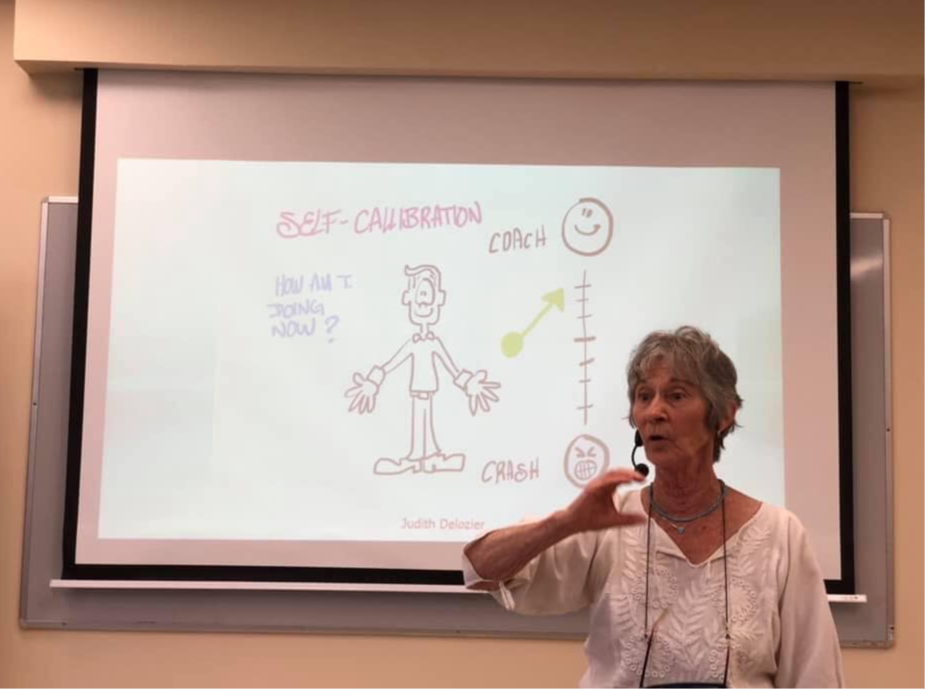
From Moscow to California, interactions with Judith DeLozier carry a quiet sense of ease and depth, where moments feel both light and profoundly meaningful at the same time. In Moscow, she dissolved all formality with a simple laugh, saying, “He was my boyfriend, after all,” instantly softening the room and turning what could have been a rigid interaction into something human and warm. In another moment, over breakfast, she smiled and said, “I invited you, not your wallet,” a small gesture that reflected both her playfulness and her grace.
Even in moments of disappointment, her presence remained steady and grounding, “No hurries, no worries,” she would say, not as a dismissal, but as a
gentle reminder to loosen the grip of urgency. Across these interactions, what becomes evident is not just what she says, but the space she creates: one where hierarchy dissolves, where people feel safe to be themselves, and where authenticity emerges naturally. She does not impose transformation or push for change; instead, she holds space for it, patiently, quietly, and with a depth that allows something real to unfold on its own.
A Global Teacher
Across places, people, and moments, her work has moved quietly through the world, shaping experiences rather than announcing itself.
Judith DeLozier’s work in NLP has travelled across spaces like Moscow, California, China, and Mexico, not as
something fixed, but as something that adapts, responds, and evolves. Through this, it has contributed to frameworks such as Systemic NLP, Generative NLP, and New Code NLP, thus expanding the field
beyond individual change into something more relational, embodied, and deeply connected to culture.

Beyond Technique
For Judith DeLozier, NLP is not simply a collection of techniques it is, in her words, “another description of life.” Her work moves beyond structured models into something far more integrative, where the body, ecology, culture, and relationships are not treated as separate domains but as deeply interconnected aspects of human experience. Rather than reducing transformation to something mechanical or
procedural, she approaches it as something relational and lived, something that emerges through awareness, presence, and the way we engage with ourselves, others, and the world around us.
She does not meet pain with urgency or the need to fix it, but with a quiet steadiness, a willingness to sit beside it, to acknowledge it without forcing change, and to allow space for something new to unfold in its own time. In this way, transformation is not an act of control, but one of permission; not something imposed, but something that arises through presence, patience, and relationship.

A Living Legacy
Judith DeLozier is not simply a contributor to NLP, she is, in many ways, its living spirit, and her impact on NLP continues to shape the field in deeply human ways. Her work does not remain confined to techniques, models, or frameworks; it continues to exist in the people she has touched, in the spaces she has transformed, and in the quiet, grounded presence she carries into every interaction. There is something enduring about the way her work lives on, not as something fixed or defined, but as something that continues to evolve through experience, relationship, and time.
To encounter her work is not just to learn something new, but to remember something
deeper, something about being human, about connection, about the possibility of change that does not force itself but gently unfolds. And perhaps that is where her legacy truly lies: not in what she taught, but in how she made people feel, seen, expanded, and capable of becoming more than they imagined.
In the end, her words return not as instruction, but as a quiet reminder which is simple, almost playful, and yet impossible to ignore:
“Life is the biggest ticket to the greatest show on earth. Don’t waste your ticket.”